Introduction
Many questions about the NBC-HWC credential eventually lead to a bigger conversation: What does it actually mean to build a successful career as a health and wellness coach?
Whether you’re newly certified, considering certification, or several years into your coaching journey, it’s natural to wonder what opportunities exist, what additional training may be helpful, and how the profession continues to evolve. While there is no single path to success, there are a few common assumptions worth exploring.
Question #1: Does the NBC-HWC Guarantee Success?
Many coaches understandably hope that earning a respected credential will lead to new opportunities, higher pay rates, more clients, or accelerated career growth.
The NBC-HWC can absolutely strengthen credibility, build confidence, and open doors that might not otherwise exist. For many coaches, board certification serves as a meaningful milestone and demonstrates a commitment to professional standards and ongoing development.
At the same time, no credential can replace the work of building relationships, gaining experience, continuing to learn, and consistently showing up as a professional. Success in health and wellness coaching is shaped by many factors, including coaching skills, communication, professionalism, persistence, and a willingness to keep growing.
The coaches who thrive often combine the foundation provided by their training and certification with real-world experience and a genuine commitment to serving others.
Question #2: Is the NBC-HWC the Only Credential You’ll Ever Need?
This question often comes from a good place. Coaches want to know whether board certification is enough or whether they should continue pursuing additional training and education throughout their careers.
Like many questions in coaching, the answer depends.
The NBC-HWC provides a strong foundation in coaching competencies, ethical practice, and professional standards. For many coaches, it serves as an important milestone and a shared benchmark within the profession.
At the same time, coaches work in a wide variety of settings and with diverse populations. Some choose to deepen their expertise through additional education in areas such as behavior change, healthcare, corporate wellness, leadership, fitness, nutrition, or other specialty areas that align with their interests and career goals.
When this conversation comes up, I often find myself thinking less about whether the NBC-HWC is enough and more about what kind of coach someone hopes to become.
Professional growth doesn’t end when a credential is earned. In many ways, it begins there. The most successful coaches I know remain curious, continue learning, and seek opportunities to expand their knowledge and skills throughout their careers.
The NBC-HWC provides an important foundation. What coaches choose to build on that foundation will look different for each individual, and that’s one of the strengths of our profession.
Question #3: Do You Have to Choose Between Employment and Private Practice?
Another misconception I frequently encounter is the idea that health coaches must choose one path and stay there.
The reality is that many coaches build careers that combine multiple roles.
Some coaches work for healthcare organizations while maintaining a small private practice. Others coach within corporate wellness programs while speaking, teaching, consulting, or developing educational content on the side.
Some begin in private practice and later move into organizational roles. Others take the opposite path.
One of the strengths of health coaching is its flexibility.
The profession does not require a single career model. In many cases, the skills developed through health coaching can be applied across multiple settings simultaneously.
Rather than thinking in terms of either/or, many coaches discover opportunities through a combination of experiences that align with their interests, expertise, and goals.
The question is often not which path to choose.
It’s about creating a career that best fits the life you want to build.
Question #4: What Does a Health and Wellness Coach Actually Do All Day?
This may be one of the biggest surprises for coaches entering the profession.
Many people imagine a health coach’s day consists entirely of coaching sessions, client after client, conversation after conversation.
While coaching is certainly an important part of the profession, it is often only one piece of a much larger role.
Depending on the position, a health coach may spend time developing programs, creating educational materials, reviewing data, documenting outcomes, meeting with stakeholders, collaborating with interdisciplinary teams, conducting outreach, supporting engagement initiatives, or evaluating program effectiveness.
In corporate wellness settings, I often found myself moving between coaching conversations, leadership meetings, program planning, and reporting. The coaching skills were always present, but not every hour of the day was spent in a coaching session.
The same is true in healthcare settings, where coaches may spend time coordinating with care teams, documenting interactions, supporting patient engagement efforts, or participating in larger wellness initiatives.
Even in private practice, the day often involves much more than coaching. There is administrative work, scheduling, marketing, content creation, networking, program development, and client follow-up. Many coaches also create courses, write books, speak at events, facilitate workshops, build online communities, or develop educational resources.
Across healthcare, corporate wellness, and private practice settings, coaches often find that coaching itself represents only part of their work. In fact, some of the most meaningful contributions health coaches make happen outside of direct coaching conversations.
When we help design healthier systems, improve employee experiences, create educational resources, support patient engagement, develop programs, or influence organizational well-being strategies, we are still applying the principles of health coaching.
The profession is often much broader than people expect, and that’s one of the things that makes it so exciting. Health coaching is not simply something we do during a coaching session; it’s a skill set that can be applied in countless ways to support healthier behaviors, healthier organizations, and healthier communities.
Conclusion
One of the things I’ve come to appreciate most about health and wellness coaching is that there is no single path forward.
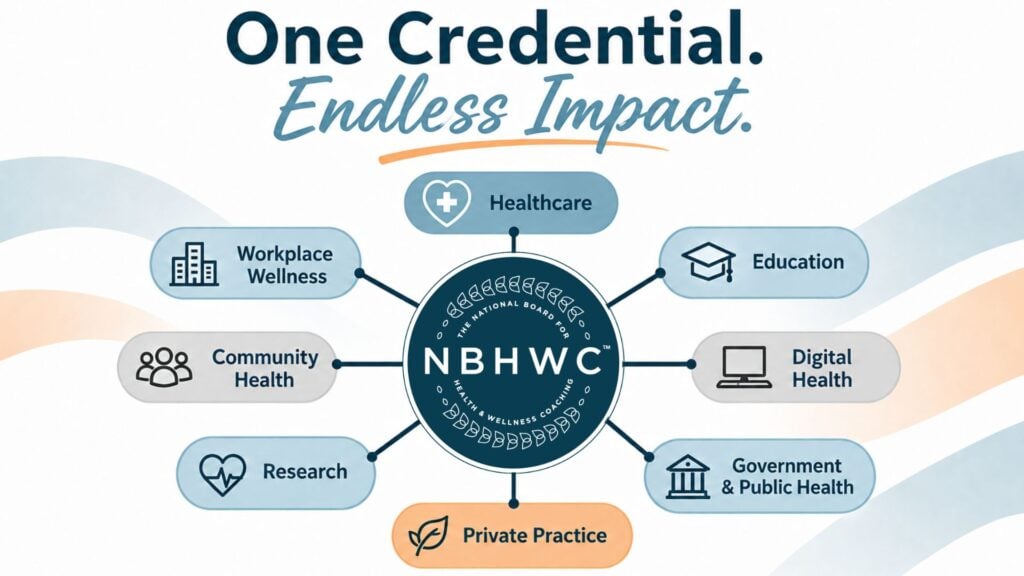
Some coaches build private practices. Others work in healthcare systems, corporate wellness programs, community organizations, educational settings, or emerging areas of the profession. Many move between these spaces throughout their careers, discovering new opportunities and applying their coaching skills in different ways.
The NBC-HWC credential can provide a strong foundation, but a coaching career is ultimately shaped by curiosity, continued learning, professional growth, and a commitment to serving others. The most successful coaches I know never stop developing their skills, expanding their perspectives, and finding new ways to create meaningful impact.
Perhaps that’s the biggest takeaway: health and wellness coaching is not defined by a job title, a practice setting, or even a credential. It is a profession built on helping people create lasting change and supporting healthier individuals, organizations, and communities.
The opportunities to do that are often far broader than we initially imagine.