This year, I was honored to be selected by the National Board for Health and Wellness Coaches as an Ambassador for their inaugural program. It’s been a milestone in my coaching career that feels a little surreal, to be honest.
Ten years ago, I was grinding away in the corporate hustle. Dropping kids off at daycare by 7 a.m., in the office by 8 a.m., and out by 4:30 p.m. so I could pick up the kids, get home, make dinner, do bath time, read books, do bedtime, and then repeat it all the next day.
I very clearly remember a conversation I had with my boss at the time, also a high-achieving working mom, who said something that made me pause and think hard about where I was headed in my career. In one meeting, she mentioned how she and her husband were like “ships passing in the night”, getting one hour to catch up every Thursday while they cheered their son on at soccer, and how 80% of their meals were takeout because no one had time to cook.
I left that meeting questioning everything I had been building in my career. I spent 80% of my week in that office and a job that didn’t feel especially impactful or meaningful to me.
To back up, I am a millennial high-achiever through and through.
I had worked hard to get to the position I was in. I started out in one of the most entry-level positions in the company, was laid off within 60 days due to a reduction in force, and networked my way around the office in the final week before my role ended, ultimately being offered another role as an assistant on the sales team.
Over the next three years, I was promoted three times and had just been selected for a “future leaders” development program for employees considered “high potential” by the company.
It all seemed like everything was going great from the outside. But in that moment, when I saw what I would need to give up to make it happen, the dream career I had been building didn’t look so dreamy..
The next year, I asked to be moved into a role with no direct reports, and went back to school.
It felt like a big shift in my career, but it was something I felt completely called to do.
I started my coaching business in 2016 while I was going through the program. As soon as I passed my PSA, I coached anyone and everyone who was willing to participate.
I completed my 50 practice coaching sessions in less than six weeks, sat for the board exam, and passed in the fall of 2017. I booked sessions early in the morning before work, at lunch, and in the evenings and on weekends.
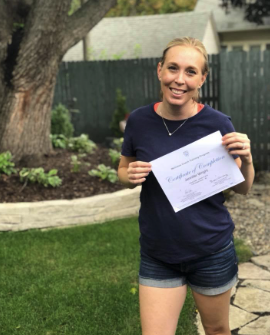
From there, I built my business into a full-time coaching practice, quit my job, and never looked back.
That feels like a lifetime ago and a blink of an eye all at the same time.
At the time, there wasn’t a program dedicated to helping coaches start a coaching business or private practice that aligned with the scope of practice of an NBHWC. So I had to piece together a lot of my experience along the way.
I learned a lot in that time. And if I could go back and do it again, I know I could save myself a lot of struggle and lost time. That is why I eventually created the Wellness Coach Business Academy. I started with the lessons I learned while building my own coaching practice and helped coaches launch their own coaching businesses with far less struggle than I experienced.
It became the foundation for Wellspired Co., helping coaches who want to launch, build, and grow a confident professional coaching business that turns their purpose into their practice.
As I reflect on the last 10 years and everything I’ve learned along the way, here are some of the biggest takeaways I would share with coaches just getting started.
Building a business in your “pockets of time” is not what you think.
When I first launched my coaching business, I followed a lot of influencers who talked about building their business in the “pockets of time.” It sounded amazing, fun, and easy.
As I got to know some of these people better, I also began to see what “pockets of time” really meant to them.
It didn’t mean they only showed up in their business when they felt like it or when an idea popped into their head. They had routines, schedules, strategy, and a dedicated commitment to developing their business.
As I built my own business, I found the same to be true. I have time flexibility, meaning I built a schedule that worked for me first and my business second. After reading Free to Focus by Michael Hyatt, I realized how important it was to make sure every activity in my business was scheduled and planned with intention. As Michael says, for everything you say “yes” to, you’re saying “no” to something else, and it’s your job to decide where your priorities lie.
This is still true for me today. I have set hours of operation for my business, with regular blocks of time reserved for content writing, video recording, and coaching sessions.
Those hours are non-negotiable because they are planned with intention, and each step builds off the next.
Here’s what I found: clients can feel the difference between a coach who offers sessions “whenever” and one with specific availability and a limited number of openings.
Not only do clients appreciate help narrowing down options, but they also take coaching more seriously. They show up. They do the work. And that professional presence starts from the first conversation you have with them.
When you show that you have a professional practice with structure and boundaries, people flex their schedule to meet your availability.
Start with Solving a Problem and Your Niche Will Follow.
When I first started my coaching business, I decided weight loss would be my niche and got to work talking to anyone and everyone about helping them lose weight.
And I hated it.
There’s nothing wrong with that choice, except that I didn’t feel particularly connected to the topic. I started to feel a heavy weight before client sessions, like I had to “build up the energy” to get through them.
Then I had a client who was a new parent, and our session topics shifted from weight loss to the struggles and challenges she was experiencing as a new mom going back to work after maternity leave.
And I suddenly noticed my energy shift as I prepared to join calls with this client.
These sessions felt different. They felt more impactful and meaningful to me, and I knew I needed to pay attention to them.
I shifted my messaging, and as I started telling people about my new coaching focus, opportunities began to show up.
A mom friend asked me to come present at her corporate office for a lunch-and-learn. A local gym asked me to lead workshops and group sessions for their mom clients. Another coach connected me with a company that partnered with tech companies to provide coaching as an employee benefit.
They loved that I specialized in working with new moms and parents transitioning back to work, as this was one of their biggest challenges in employee retention.
In working with them, they were able to show data around improved employee retention after maternity leave, increased job satisfaction for employees returning to work, and fewer symptoms of burnout.
So many coaches feel pressure to have the perfectly defined niche figured out before they start, and that’s often not how it works. Start by solving a problem your clients are willing to pay you to coach them on. Then, find the common themes between the clients you worked with. That will help guide you to your niche.
You don’t need a fancy website.
Over the years, I have seen many coaches’ websites and talked to coaches who have spent a small fortune designing a brand and a website, only to later realize that the niche they thought they wanted to work with wasn’t actually the right fit for them.
Then, I watched them go through the process all over again as they adjusted.
Over time, I came to learn that coaching practices have phases: the start-up phase, the Book 5 phase, the build phase, and beyond.
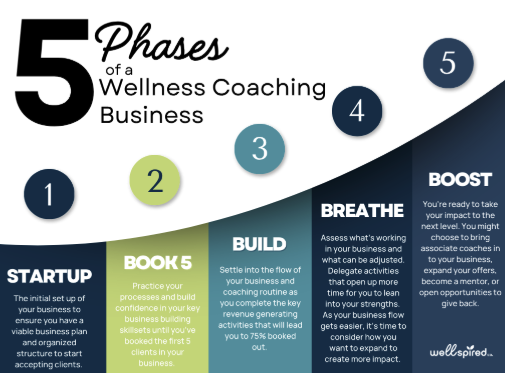
Source: Wellspired Collaborative, LLC
When a coach is in the start-up phase or working toward their first five clients, there is still so much exploration and discovery happening that it often doesn’t make sense to invest heavily in a website right away.
Start with a simple one-page website until you book your first 5 to 10 clients. Validate that you have found a target audience or niche you are committed to, and then upgrade to a more polished website if you want.
Anything before that is likely to change.
Tell Everyone What You Do And Why You Do It.
At Wellspired Co., we have now had more than 3,000 coaches go through our training and programs, and we see common themes among the coaches who do well and build successful coaching businesses.
And most importantly, they talk about their business with passion and excitement, even if they don’t say it all perfectly.
They believe so much in the value of coaching that they simply can’t help but get it out there.
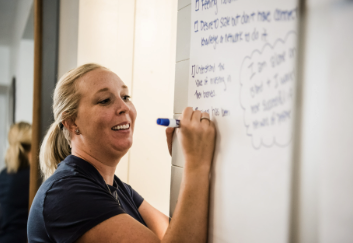
You have all the skills you need to be a great coach now.
When I first started as a coach, I was so worried about saying the wrong thing to my clients. It often meant I was more consumed by what I was going to say than fully present in the session.
Today, I’m on a mission, as a coach, to normalize this in the development process. I don’t know a single coach who hasn’t felt this way when they began.
Rich Litvin writes in The Prosperous Coach, “The struggling coach thinks confidence is a requirement before taking action. The Pro coach knows that confidence is a result of taking action.”
Your client doesn’t care if you didn’t ask the perfect, powerful question or use a double-sided reflection at the right moment.
Will those skills help you become a better coach? Sure.
But in the beginning, being present and knowing that you have the foundational skills to offer safe, effective coaching is what matters most.
And when you become less worried about following the textbook and lean into being present to your client, some pretty amazing things can happen.
As coaches, we know our clients need to do the work, so it can be easy not to give ourselves credit. But the presence, space, and reflection you offered in that session might have been exactly what they needed in that moment, more than you realize.
And without you in that session, it wouldn’t have happened.
I promise you: you’re a better coach than you’re giving yourself credit for.
Decide that the impact you make with your clients is more important than the fear you’re holding onto about being imperfect in a session.
The Business of Coaching is a Journey, Not a Sprint.
If you’re watching other coaches who seem to have overnight success, there’s probably more to the story than they are sharing.
They may not be sharing the years of experience they spent building their network, the family member who is extremely connected in the community, or the three other businesses they tried to start before they finally found what worked.
Just like any business, starting a coaching business is a journey. And building a coaching business well, with heart and impact, means creating personal connections and human interactions that allow your clients to be seen and heard.
Building a coaching business isn’t a short-term project. It’s a commitment you’re making to the people you want to serve and impact.
This is not only about clarifying the right strategy for your business. It’s also a personal exploration of who you are as a coach in the process.
That takes time, patience, and the ability to get through a few bumps in the road.
But when you make it to the other side and see the clients who have transformed their lives because of the work you did with them, those challenging moments in your business will feel worth it.
Because you were part of their story, and they were part of your journey.
References:
Full Focus. Free to Focus: A Total Productivity System to Achieve More by Doing Less. Accessed June 23, 2026. https://fullfocusstore.com/products/free-to-focus
Steve Chandler and Rich Litvin, The Prosperous Coach: Increase Income and Impact for You and Your Clients (Maurice Bassett, 2013).
Wellspired Co., 5 Phases of a Wellness Coaching Business. https://wellspired.co
About the Author

Jen Wright, NBC-HWC, is the Founder and CEO of Wellspired Co., a professional development and business education company for certified health and wellness coaches.
Through Wellspired Co., Jen supports coaches through the Wellness Coach Business Academy, a business-foundations program for coaches launching or relaunching their practices; the Wellness Coach Business Retreat, a continuing education and practice-growth summit; and the Wellness Coach Business Network, a mentor-led professional community for health and wellness coaches.
Jen has spoken for conferences, colleges, and university programs across the country. Through her work, she helps coaches build confident, well-aligned practices that create lasting impact for their clients and themselves.
When Jen isn’t presenting a workshop or in a coaching session, you’ll often find her enjoying Minnesota’s many lakes, cycling through the state, or taking her kids to the latest escape room experience.
NBHWC Disclaimer
While the author mentions their organization, this is not an endorsement by NBHWC, nor was this post written to promote a specific program or continuing education course. Wellspired Co is an NBHWC Approved Continuing Education provider. NBHWC Continuing Education Approval indicates that an activity meets NBHWC continuing education standards. Approval does not imply endorsement by NBHWC of any specific content, opinions, recommendations, products, services, therapeutic approaches, or organizations discussed. The views and opinions expressed are those of the author and do not necessarily reflect the views of NBHWC.