Honoring Our Foundation as We Forge the Path Forward
At certain points in a profession’s development, it is important to look back — not only to celebrate progress, but also to remember how we arrived here, who helped build the path, and what we must continue to nurture as we move forward.
For health and wellness coaching, pursuing sustainable reimbursement marks a significant part of that journey. It is neither the profession’s entire story nor a finished one. Rather, it is an important milestone in a much larger effort to advance the profession, expand access, and continue cultivating its contribution to health and well-being — with the standards, evidence, collaboration, and accountability needed for continuous evolution and lasting growth.
The foundation established before reimbursement
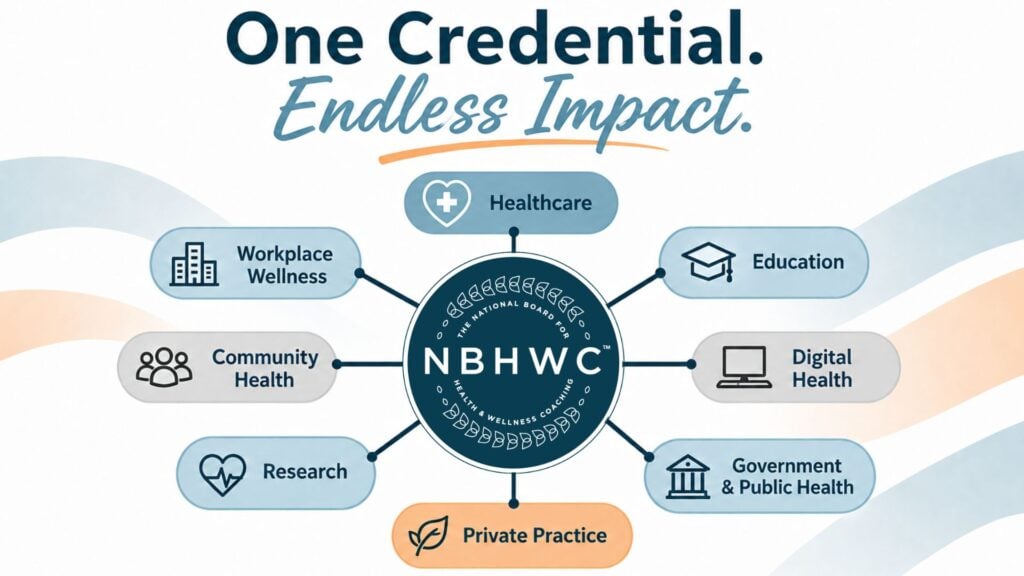
Long before Medicare reimbursement became a realistic policy prospect, leaders across the field were undertaking the less visible work essential to an emerging profession: defining competencies; setting education and training standards; creating a national board certification process; establishing ethics and scope; developing the evidence base; and demonstrating how health and wellness coaching could contribute across healthcare, community, workplace, private-practice, and other settings.
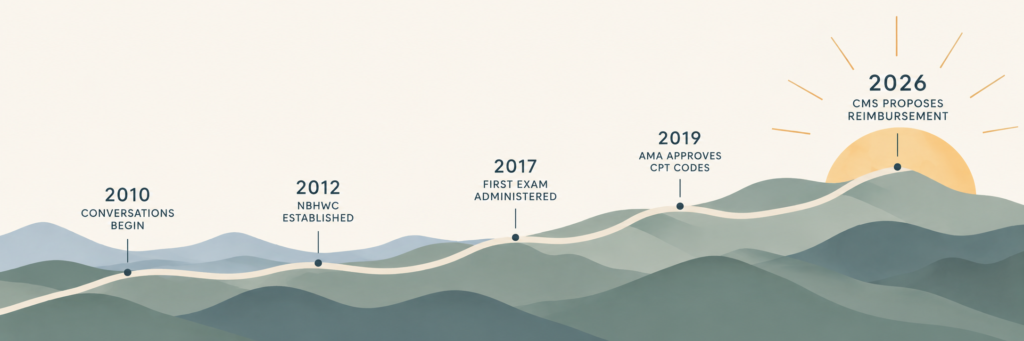
NBHWC’s history traces this progression. Conversations about professional standards began in 2010, and the organization was established in 2012. Job Task Analyses and training requirements followed. A partnership with the National Board of Medical Examiners supported rigorous development of the national board examination, first administered in 2017. In 2019, the American Medical Association approved Category III CPT codes for health and well-being coaching, effective in 2020, establishing a standardized way to report these services and advance discussions about utilization and payment. [1-2] Developing and updating the Compendium of Health and Wellness Coaching has also helped organize the community’s growing research base while highlighting important opportunities for continued inquiry and development. [3]
These milestones built on one another. Successive generations of founders, executive directors, staff, board members, commissions and committees, volunteers, educators, researchers, coaches, and collaborators strengthened the foundation for each next step. [4]
A significant milestone — not the finish line
In July 2026, the Centers for Medicare & Medicaid Services (CMS) released the proposed CY 2027 Medicare Physician Fee Schedule. For health coaching, CMS proposed national payment for CPT codes 0591T, 0592T, and 0593T, together with proposed payment conditions and valuations. The proposal also addressed certification standards and other implementation details. The public comment period closed on September 14. [5-6]
This is a consequential milestone, but precision is essential: these provisions are proposals, not final Medicare policy. We now await the final CY 2027 rule. Regardless of what CMS ultimately adopts, reaching this stage of federal rulemaking reflects years of evidence development, implementation experience, policy work, collaboration, and advocacy.
To every NBC-HWC, researcher, educator, clinician, healthcare leader, employer, patient advocate, training program, partner organization, and member of our broader community who reviewed the proposal, shared evidence or experience, contacted policymakers, or submitted public comments: thank you. Your participation reflects more than support for a policy proposal. It demonstrates a community willing to engage thoughtfully, constructively, and collectively in decisions that may shape the profession’s future.
A profession built by its community
Progress of this kind rarely comes from one person, one organization, or one era of leadership. NBHWC’s founders and early volunteers created the standards and infrastructure that underpin much of today’s work. Our executive director and staff transformed those aspirations into the daily work of a growing professional organization. Successive Board Directors provided strategic leadership and stewardship through pivotal decisions. Researchers strengthened the evidence base; coaches built practical experience; and training programs prepared professionals. Health systems, clinicians, academicians, educators, employers, professional and community organizations, and other partners created opportunities to test, refine, and expand coaching in real-world settings.
Our reimbursement efforts have depended on collaboration with more than 100 healthcare systems, academic centers, professional societies, credentialing bodies, workplaces employing coaches, researchers, policy colleagues, and others — including NBHWC co-founder Margaret Moore, a long-standing reimbursement collaborator — who contributed data, expertise, implementation experience, and advocacy.
We offer special thanks to the Veterans Health Administration’s leadership, staff, and coaches for advancing whole-person care, with health and wellness coaching as an integral part, and for setting early examples of thoughtful, meaningful practice. This profession was built by a community, and its progress belongs to that community.
Maintaining clarity as the field expands
As health and wellness coaching continues to expand, so too will the settings in which coaches practice, the populations they serve, the evidence that informs their work, and the opportunities available to the profession. Growth makes clarity increasingly important. The NBC-HWC credential represents a defined and rigorous education and training pathway, coaching experience, assessment of individual competence through a national board examination, expectations for ethics and scope of practice, and continuing professional standards. These elements were developed deliberately because meaningful standards foster trust among the public, coaches, employers, healthcare organizations, policymakers, and the many communities in which health and wellness coaches serve.
Confidence in that foundation should never become overstatement. A credential alone cannot establish that every coaching intervention will be effective in every population, setting, or circumstance. The evidence base continues to grow and evolve, with findings that vary according to intervention design, population, setting, comparator, and outcome. That is part of the natural evolution of a growing profession—and an invitation to continue learning. Our responsibility is to strengthen the credential value, enhance the evidence, refine practice, learn from implementation, understand where coaching contributes most meaningfully, and translate that knowledge responsibly as the profession expands.
Beyond reimbursement: cultivating growth, value, and possibility
Reimbursement is an important part of this journey, but it is only one part. Health and wellness coaching has already built a substantial foundation. Qualified coaches serve individuals and communities across healthcare systems, workplaces, private practice, community settings, public institutions, education, research, and many other environments. The profession has established national standards, developed a growing body of evidence and practice experience, and demonstrated increasingly diverse ways in which health and wellness coaches can contribute to health and well-being.
The opportunity ahead is to continue cultivating, understanding, expanding, and enriching that value — strengthening what has been accomplished, learning where coaching can contribute even more meaningfully, addressing the questions that remain, and opening new possibilities as the needs of individuals, communities, organizations, and health systems evolve.
Within healthcare, that includes continuing the work toward sustainable reimbursement and access while learning from implementation. How can coaching integrate effectively alongside physicians, nurses, care managers, behavioral health professionals, dietitians, and others? Which outcomes matter most to patients, health systems, payers, and society? How can we continue improving quality and fidelity while adapting responsibly across populations and settings? And how might emerging technologies, including artificial intelligence, responsibly support — rather than diminish — the relational, behavioral, and deeply human work central to coaching?
These are questions that accompany continued growth — and opportunities to deepen the contribution health and wellness coaching can make.
A mission larger than reimbursement
At the same time, neither reimbursement nor healthcare alone defines this profession — or NBHWC’s responsibility to it. NBHWC is first and foremost a credentialing body. At the heart of our responsibility is establishing and maintaining meaningful standards for education, training, credentialing, ethics, and professional practice, while safeguarding the integrity and public trust represented by the NBC-HWC credential. That foundation remains central to who we are. But serving a growing profession also means continually asking how, within those boundaries, we can help the community around that credential flourish and sustain itself.
That responsibility reaches across the many settings and pathways in which health and wellness coaches practice and contribute. It includes cultivating education and professional development; strengthening research and the translation of evidence into practice; building meaningful partnerships; expanding public, professional, and institutional understanding of qualified coaching; supporting the evolution and sustainability of the profession; and thoughtfully exploring new pathways through which coaches can serve individuals, organizations, communities, and society.
Many of those possibilities are already taking shape. NBHWC has continued to share new developments, offerings, partnerships, and opportunities in recent years. Some strengthen foundations already built; others create new possibilities. More endeavors and opportunities will continue to unfold as we listen to our community, learn from evidence and experience, and consider how best to serve a profession that continues to grow.
Our mission provides the anchor, and our vision keeps us focused on why this work matters. Together, they give us both clarity of purpose and room to grow. New questions, opportunities, partnerships, and challenges lie ahead, and we must meet them as we have reached this point: with rigor and curiosity, confidence and humility, collaboration and generosity, and an unwavering commitment to service. Our small but mighty staff team, led by Executive Director Deanna Fournier, embodies these commitments — embracing each opportunity and meeting each challenge with genuine care, focus, and determination.
We have inherited something valuable from those who began this work, and we remain grateful to everyone carrying it forward today. Our responsibility is not simply to preserve what has been built, but to cultivate it—to strengthen its foundations, expand its reach, enrich its possibilities, and shape its next chapter together. That is how we will honor the work that brought us here and continue forging the path forward.
On behalf of the Board of Directors,
Moain Abu Dabrh, MBBCh, MS, NBC-HWC
Chair, Board of Directors | National Board for Health & Wellness Coaching
Selected historical and policy references
1. NBHWC. Who Are We? Organizational history and milestones. https://nbhwc.org/about/
2. NBHWC. CMS Proposed Rule: Health & Wellness Coaching Coverage. Reimbursement history and CPT milestones. https://nbhwc.org/cms-proposed-rule-health-wellness-coaching-coverage/
3. Abu Dabrh AM, Weiss JM, Munipalli B, Kaye MP, Smith K, Shur E, Harenberg S, Garofalo R, Mohabbat AB, Robinson A, Paul SN, Beech BM, Moore M, Brigham TJ, Sforzo GA. Compendium of Health and Wellness Coaching: 2023 Addendum. J Integr Complement Med. 2025 Aug;31(8):726-736. doi: 10.1089/jicm.2024.0672. Epub 2025 Mar 28. PMID: 40152886.
4. Abu Dabrh AM, Reddy K, Beech BM, Moore M. Health & Wellness Coaching Services: Making the Case for Reimbursement. Am J Lifestyle Med. 2024 Jul 19;19(6):800-813. doi: 10.1177/15598276241266784. PMID: 39554945; PMCID: PMC11562341.
5. Centers for Medicare & Medicaid Services. CMS-1848-P: CY 2027 Payment Policies under the Medicare Physician Fee Schedule and Other Changes to Part B Payment and Coverage Policies. Displayed July 14, 2026; comment period closed September 14, 2026. https://www.cms.gov/medicare/payment/fee-schedules/physician/federal-regulation-notices/cms-1848-p
6. Centers for Medicare & Medicaid Services. CY 2027 Medicare Physician Fee Schedule Proposed Rule, Health Coaching (CPT codes 0591T, 0592T, and 0593T), public inspection version, pp. 193-196. https://public-inspection.federalregister.gov/2026-14327.pdf