Millions of people set goals with a health coach every year. Most quietly abandon them. Not because they lacked a plan, but because the focus was on what they needed to do rather than who they needed to become. Coaching through change is not just about action steps. It’s about transforming the inner landscape, making lasting change possible.
The Problem with Focusing on the Doing
Imagine a client or patient you have had. The person comes to their health coach frustrated. She tried every sleep app. She has memorized every recommended sleep hygiene strategy. She’s read all the books and gamified her way into building habits. And yet, six months later, she’s back at square one, wondering what’s wrong with them.
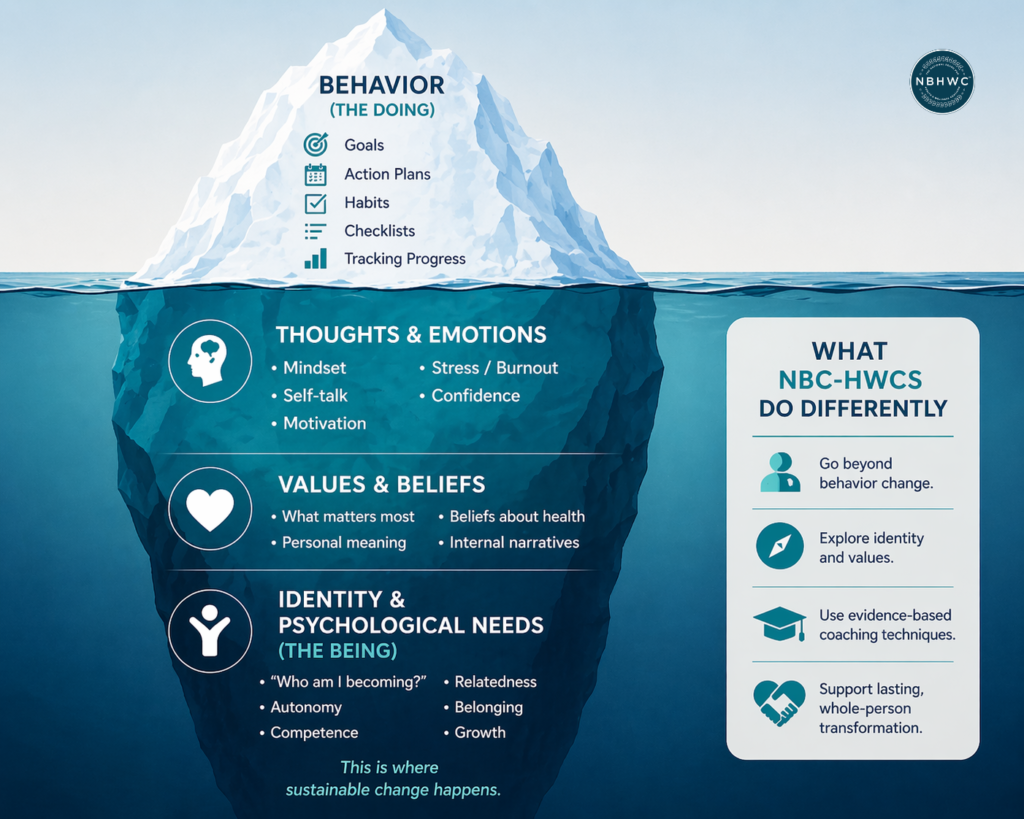
Of course, as coaches, we know nothing is wrong with them. The problem is that every strategy they’ve tried has been aimed at her behavior, the doing, without ever addressing the being underneath it all.
Behavioral change models, while valuable, often assume that if someone receives the right information and plan, they’ll follow through. But research in neuroscience, coaching, and motivational psychology tells a different story. According to Self-Determination Theory (Deci & Ryan, 1985), sustainable behavior change requires three core psychological needs: autonomy, competence, and relatedness. When coaching focuses solely on doing, it often bypasses all three.
The result? Short-term compliance. Long-term relapse.
Coaching the Being: What it Actually Means
Coaching the being means entering the conversation beneath the surface, the “thing behind the thing”. Beneath the sleep hygiene tips, exploration is needed with deeper questions.
- What is this person’s relationship to sleep and change?
- What story are they telling themselves about their capacity to succeed?
- What values, fears, or beliefs are quietly running the show?
This is the domain of identity. And identity is where lasting change lives (Lazarus, 2025).
James Clear, author of Atomic Habits, argues that the most effective way to change behavior is to first change your belief about who you are (Clear, 2018). When someone shifts from “I’m trying to go to bed earlier each night” to “I am someone who values my wellbeing and knows 8 hours of sleep makes me feel at my best,” the behavior stops being an obligation and starts being an expression of self. That is a profoundly different relationship to change.
A skilled coach who coaches the being doesn’t skip the planning but builds a foundation of self-awareness, values alignment, and identity. They ask: “What kind of person do you want to be and what would that person naturally do?”
Why “Being” Must Come First: The Neuroscience
The brain is not a logic machine that responds to good arguments. It is a pattern-recognition system wired to protect the familiar. When change threatens a person’s sense of identity, even when it is positive, the brain’s default mode network activates resistance (Hagger et al., 2020).
This is why willpower-based approaches consistently fail over time. The prefrontal cortex simply cannot sustain the effort required to override deep-seated patterns indefinitely. But when change is congruent with identity, when the person genuinely sees themselves as the kind of person who makes healthy choices, the need for “willpower” diminishes dramatically.
Coaches who address the being help clients rewire these patterns at the root. Through powerful questions, reflective listening, and values exploration, they create the conditions for neurological and psychological shifts that no checklist can produce.
What This Looks Like in Practice
Coaching the being doesn’t require a psychology degree; it requires a commitment to going deeper. Here’s what the shift looks like in types of questions you might ask:
What steps do you plan to take? Vs. What do you need?
What has worked for you in the past? Vs. What does this tell you about you?
How will you measure your progress? Vs. How do you feel about your progress?
What goal do you want to set? Vs. What are you learning about yourself?
What skills do you need to achieve your plan? What changes if you loosen your grip on this belief?
Closing: Key Takeaways
Coaching the doing produces short-term compliance. Coaching the being produces lasting transformation.
Identity is the architecture of behavior. When a person’s sense of self shifts, their actions follow more sustainably.
Resistance is a signal, not a flaw. When a client struggles to follow through, the coach’s job is to get curious about the person beneath the behavior, not push harder on why the plan didn’t work.
Real change is an inside job. The role of a skilled wellness coach is not to be the expert on what the client should do, but to be a compassionate guide to who they are becoming.
believe they are. Because the gap between knowing and doing is almost never a knowledge problem. It’s an identity problem. And that is exactly the terrain that exceptional coaching is designed to navigate.
Change is not a doing problem. It never was.
Are you ready to go deeper in your coaching practice? Explore NBHWC-approved continuing education resources and discover how identity-based coaching can transform your clients’ results and your impact as a wellbeing professional. Visit our Why Board Certification Matters to learn more.
Clear, J. (2018). Atomic Habits: An Easy & Proven Way to Build Good Habits & Break Bad Ones. Avery.
Deci, E. L., & Ryan, R. M. (1985). Intrinsic Motivation and Self-Determination in Human Behavior. Plenum Press.
Hagger, M. S., Moyers, S., McAnally, K., & McKinley, L. E. (2020). Known unknowns in dual-process models: Implications for research on reflex and reflection in physical activity. Health Psychology Review, 14(1), 1–25.
Lazarus A. Exploring identity in coaching – insights into coaches’ understanding and approach. Front Psychol. 2025 Feb 5;15:1445643. doi: 10.3389/fpsyg.2024.1445643.